When 'Done' Is Enough: Helping Kids Escape the Perfectionism Trap and Actually Enjoy What They Create
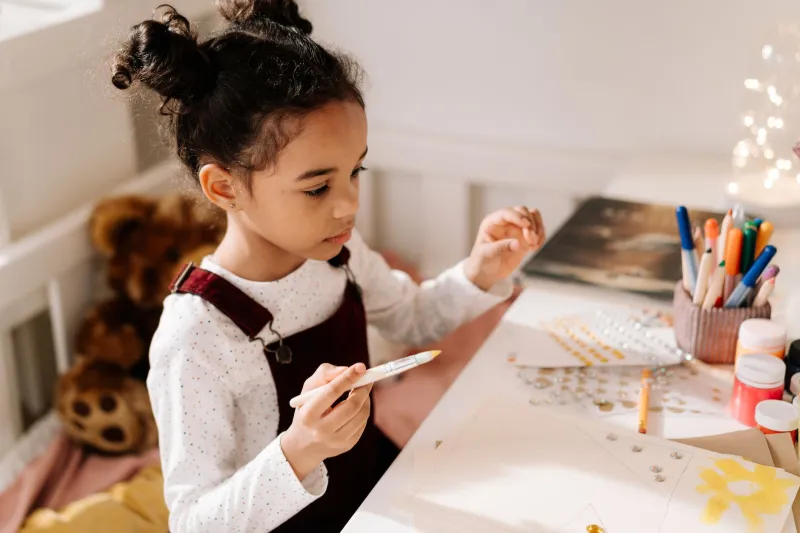
There's a moment a lot of parents know well. Your kid is drawing, building, writing, or painting—and then, without warning, the whole thing gets crumpled up, knocked over, or erased. Not because they ran out of ideas. Because it wasn't perfect.
It's one of those quietly heartbreaking things to watch. A child who was full of energy and excitement just a minute ago suddenly decides their work isn't good enough—and gives up entirely rather than keep going with something imperfect.
Here's the thing: perfectionism isn't a sign that your kid has high standards. More often, it's a sign that they've started to believe the process only matters if the product is flawless. And that belief? It's one of the biggest creativity killers out there.
Where Does Perfectionism Come From, Anyway?
Kids aren't born perfectionists. That tendency gets learned—and it usually comes from a mix of sources that are honestly pretty hard to avoid in modern American childhood.
School culture plays a huge role. When kids get feedback primarily in the form of grades, stars, or scores, they start to internalize the idea that output is what counts. The effort, the exploration, the wild ideas that didn't quite work out—those don't show up on a report card.
Well-meaning praise can also backfire. When we tell kids they're "so smart" or "so talented," research consistently shows they become more risk-averse, not less. They start protecting that identity rather than testing its edges. Suddenly, trying something hard and failing feels like proof that the label was wrong all along.
And then there's the comparison factor. Between social media, competitive extracurriculars, and the general buzz of achievement culture, kids are surrounded by highlight reels. They see the finished science fair project, the polished recital performance, the spotless art room display. They rarely see the seventeen drafts, the off-key practice runs, or the painted-over mistakes underneath.
What Perfectionism Actually Costs Kids
The sneaky thing about perfectionism is that it looks a lot like ambition from the outside. But inside a child's experience, it usually feels like fear.
Kids who are stuck in perfectionist patterns often avoid trying new things altogether—because if you never attempt it, you can never fail at it. They may rush through activities just to get them over with, or drag their feet endlessly because starting means risking imperfection. Creative play, which is supposed to be the freest, most joyful part of childhood, starts to feel like a performance.
Over time, this shrinks a kid's world. They stick to what they're already good at. They stop experimenting. They lose the beautiful, scrappy willingness to just make something without knowing how it'll turn out—which, if you think about it, is pretty much the foundation of every creative and innovative thing humans have ever done.
Modeling 'Good Enough' Out Loud
One of the most powerful things you can do is let your kid see you embrace imperfection—and narrate it while you do.
Burn the pancakes? Say, "Oops, these got a little crispy—still tastes good to me!" Mess up a word in a text and read it out loud with a laugh. Start a home project, hit a snag, and say, "I'm not totally sure how to do this part, but let's try something and see what happens."
This kind of casual, out-loud modeling tells kids something they desperately need to hear: mistakes are just part of doing things. Not a verdict. Not a disaster. Just part of it.
It sounds almost too simple, but children are watching how adults handle imperfection constantly. When we hide our mess-ups or get visibly frustrated with ourselves, we're sending a message. When we shrug it off and keep going, we're sending a very different one.
Shift the Praise from Product to Process
Instead of leading with "That looks amazing!" try getting specific about the doing.
- "I noticed you kept trying even when that part got tricky."
- "You came up with like five different ideas before you picked one—that's really cool."
- "I love that you tried a totally different color than you planned."
This kind of feedback—sometimes called process praise—helps kids build what psychologists call a growth mindset. It ties their sense of accomplishment to their effort and curiosity rather than to a polished final result. And it gives them something to feel proud of even when the thing they made isn't perfect. Which, let's be honest, is most things, most of the time.
Create Low-Stakes Creative Zones
At Emily's Playground, we're big believers in the idea that kids need spaces—physical and emotional—where the whole point is to just play around without any pressure attached.
Try designating a sketchbook that's purely for doodling with no audience. Set up a craft corner where the rule is that nothing has to look like anything. Play games where the goal is fun and silliness, not winning. Let your kid cook with you and celebrate the weird-looking cookies right alongside the pretty ones.
When low-stakes creative play becomes a regular part of life, kids start to rebuild their relationship with imperfection. It stops being a threat and starts being just... what making things looks like.
You can also try what some parents call a "done is done" rule: once a drawing is finished, it's finished—even if you want to change it. This gently helps kids practice releasing the urge to endlessly revise and just let something exist as it is.
Talk About the Unfinished Stuff You Love
Here's a fun one: share examples of famously imperfect or unfinished things that turned out to be wonderful anyway.
Tell your kid that some of the most beloved songs were written in an afternoon. That plenty of classic books have typos. That inventors fail hundreds of times before something works. That even professional athletes have off games—and keep playing anyway.
Better yet, find examples together. Look up famous bloopers, beautiful art made from mistakes, or inventions that came from accidents. It turns into a great conversation and quietly reinforces the message: imperfection isn't the opposite of greatness. Sometimes it's the path to it.
The Real Goal Isn't Lowering Standards
It's worth saying clearly: helping your kid let go of perfectionism isn't about teaching them not to care. It's about helping them care about the right things.
A kid who's free from perfectionism still tries hard. They still want to do well. But they're also willing to start before they feel ready, keep going when things get messy, and finish something even when it's not exactly what they imagined.
That's not a lower bar. That's actually a higher one—because it requires courage, resilience, and genuine engagement with the process. Those are the things that lead to real growth, real creativity, and real joy.
And honestly? A drawing that's a little wobbly, a story that takes a weird turn, a birdhouse that leans slightly to the left—those things are often the most alive. They're proof that a real kid made them, with real effort, and kept going anyway.
That's worth a lot more than perfect.