Just Be There: The Surprising Brain Science Behind Doing Absolutely Nothing With Your Kid
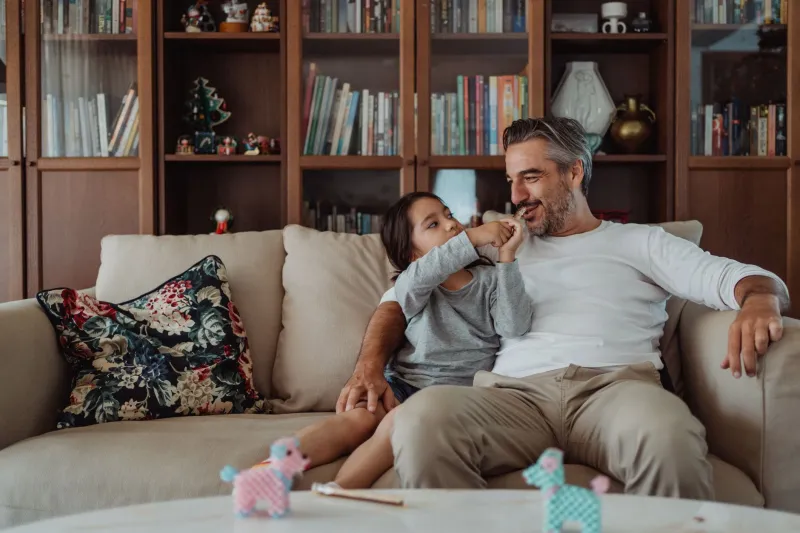
You've probably had this feeling before. You're sitting on the couch next to your kid, nobody's doing anything particularly important, and a small voice in the back of your head starts whispering: Shouldn't we be doing something? Maybe a craft. Maybe a vocabulary game. Maybe literally anything more productive than this.
Here's the thing—that whisper is wrong. And neuroscience is ready to back that up.
Your Brain on "Nothing"
When we talk about the brain, we tend to celebrate the busy moments. Learning a new skill, solving a puzzle, reading a book. But researchers have spent the last two decades getting increasingly excited about what happens in the brain when nothing much is going on.
The default mode network—a cluster of brain regions that lights up during rest and unstructured thought—turns out to be one of the most important systems in the developing mind. It's active when kids daydream, reflect, and simply exist alongside the people they love. Far from being "offline," this network is doing serious heavy lifting: processing emotions, building social understanding, and cementing memories.
When you sit with your child without a plan, without an objective, without a teachable moment queued up—you're giving that network room to breathe. And that, it turns out, is a gift.
What "Quality Time" Gets Wrong
The phrase "quality time" has done a number on American parents. Somewhere along the way, it got tangled up with productivity. Quality time started to mean intentional time—structured, educational, enriching. The kind of time you can describe at a dinner party and feel good about.
But kids don't experience time that way. For a child, quality isn't about what you're doing. It's about whether you're present. Whether you seem like you want to be there. Whether they feel like they have access to you—not a version of you that's facilitating an activity or sneaking in a life lesson, but just... you.
Psychologists who study secure attachment consistently find that children develop the deepest sense of safety not through grand gestures or perfectly curated experiences, but through repeated, low-stakes moments of togetherness. The kind where nobody's performing. The kind where it's okay to be a little bored.
The Invisible Work of Being Together
Here's what's actually happening when you and your kid are just hanging out:
Co-regulation is kicking in. Children's nervous systems are still developing, and they literally borrow regulation from the calm adults around them. When you're relaxed and present—not rushing, not optimizing—your child's stress response settles too. This is one of the earliest and most enduring ways parents shape kids' emotional baseline.
Attachment is being reinforced. Every moment your child glances over and finds you there, unhurried and available, they're filing away evidence: I am safe. I matter. My presence is enough. That evidence accumulates into something researchers call a secure attachment style—and it predicts better friendships, more resilience, and healthier relationships well into adulthood.
Language and social cognition are developing. Unstructured time together is full of spontaneous conversation—the weird, wandering kind that doesn't have a point. Kids who have lots of this kind of talk with adults develop richer vocabularies and stronger theory of mind (the ability to understand that other people have their own thoughts and feelings). You can't manufacture this with a flashcard set.
Why Parents Struggle to Just Sit Still
Let's be honest: doing nothing is hard for grown-ups. We live in a culture that treats busyness as a virtue and stillness as laziness. When we're with our kids, the urge to do something with them can feel almost moral—like we're being better parents if we're actively engaged, teaching, playing a structured game, or building toward some developmental milestone.
But that urge is worth examining. Sometimes it's about our kids. Often, though, it's about us—our discomfort with unstructured time, our anxiety about whether we're doing enough, our need to feel useful. And when we act on it by constantly initiating activities or steering conversations toward learning moments, we're actually communicating something to our kids: just being together isn't quite enough.
Kids pick up on that. And over time, it can make them feel like they need to entertain, achieve, or perform to earn your full attention.
How to Get Comfortable With Unplanned Time
If the idea of sitting with your kid and doing nothing sounds either blissful or mildly terrifying, you're probably a normal parent. Here are a few ways to ease into it:
Follow their lead, fully. If they want to sit and watch clouds, watch clouds. If they want to narrate a story about their LEGO minifigures for twenty minutes, listen like it's the most interesting thing you've heard all week. Resist the urge to redirect or improve the activity.
Put the phone away—for real. Not face-down. Away. The research on parental phone use is pretty uncomfortable: even a phone sitting on a table reduces the quality of connection kids feel. Your physical presence isn't the same as your actual presence.
Let silence exist. Not every quiet moment needs to be filled. Comfortable silence between a parent and child is actually a sign of a secure relationship. Let it be there.
Notice what comes up. Some of the most meaningful conversations happen in these unplanned moments—in the car, on the porch, while you're both staring at the ceiling. Kids talk when they feel safe, not when they're prompted.
The Playground Version of Parenting
At Emily's Playground, we talk a lot about how kids learn through play—through mess and exploration and following their own curiosity. The same principle applies to how parents can show up. The best moments often don't happen on a schedule. They happen in the margins, in the slow afternoons, in the side-by-side quiet that doesn't look impressive from the outside but is doing profound work underneath.
So the next time you find yourself sitting next to your kid with no particular plan, resist the whisper. You're not wasting time. You're building a brain. You're building a relationship. And honestly? You're probably doing some of your best parenting right now.