Copycat Kids Are Actually Creative Geniuses—Here's the Science That Proves It
You've probably seen it happen. Your kid sits down next to a friend who's drawing, and within minutes, they're copying the same subject, the same colors, the same general composition. Or they spend a week talking exactly like their favorite cousin—same slang, same laugh, same way of shrugging. Or they watch an older kid do a cartwheel approximately forty-seven times before trying it themselves.
And somewhere in the back of your brain, a little worry pops up: Are they just copying? Shouldn't they be doing their own thing?
Here's the thing. They are doing their own thing. Imitation is not the absence of independent thinking. In children, it's actually one of the most sophisticated cognitive strategies available—and understanding why can completely change how you respond when you see it happening.
What's Actually Going On in That Copying Brain
Developmental psychologists have spent decades studying imitation in children, and the findings are pretty remarkable. From infancy, humans are wired to learn through observation and replication. Babies mimic facial expressions within hours of birth. Toddlers watch and repeat actions with striking precision. School-age kids use peer imitation to rapidly absorb social norms, physical skills, and creative techniques.
This isn't passive absorption. It's active, effortful processing. When a child watches someone else do something and then tries to replicate it, their brain is doing several things simultaneously: encoding the sequence of actions, predicting outcomes, mapping the movements onto their own body or hands, and monitoring the gap between what they're doing and what they observed. That's genuinely complex cognitive work.
There's also a social intelligence layer. Kids are remarkably selective about who they imitate. They tend to copy people they admire, people who seem competent, and people who are slightly ahead of them developmentally—not so far ahead that it's impossible, but far enough that it's a stretch. That selectivity is itself a sign of sophisticated social reasoning.
The Craft Table Is a Perfect Lab for This
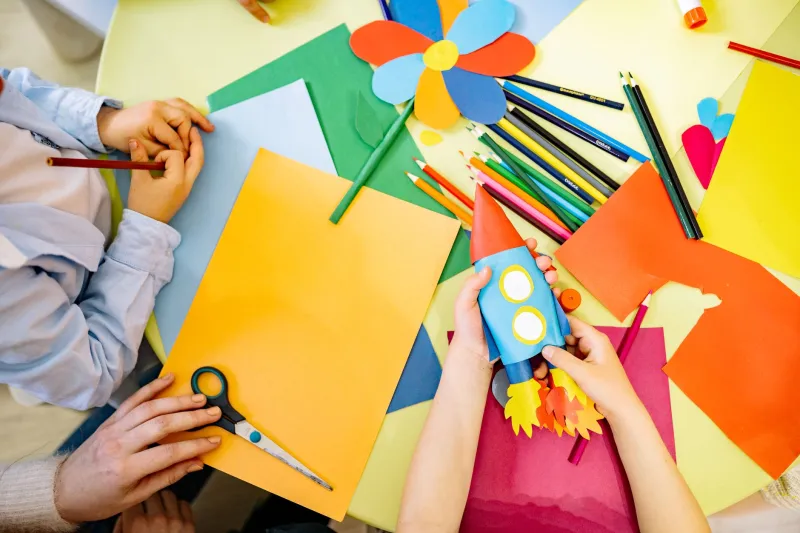
At Emily's Playground, we talk a lot about creative activities as spaces for learning—and imitation play is one of the most underrated dynamics at the craft table. When a child watches a peer cut paper in a certain way and then tries it themselves, they're not being unoriginal. They're acquiring a technique. Once they have it, they can start adapting, combining, and eventually innovating.
Think about how any skill is actually learned. A beginning musician plays scales and covers other people's songs before writing their own. A young athlete watches and mimics the form of players they admire before developing their own style. Painters study other painters. Writers read voraciously before finding their voice. The path to genuine originality almost always runs through imitation, not around it.
Children are doing the same thing—just faster, louder, and with more glitter involved.
Three Types of Imitation (And What Each One Means)
Not all copycat behavior is the same, and it's worth knowing what you're actually looking at.
Skill-acquisition imitation is when a kid copies a technique or process—how someone holds scissors, how a friend structures a story, how a classmate approaches a math problem. This is almost always healthy and productive. It's your kid recognizing a better method and adopting it. Encourage it.
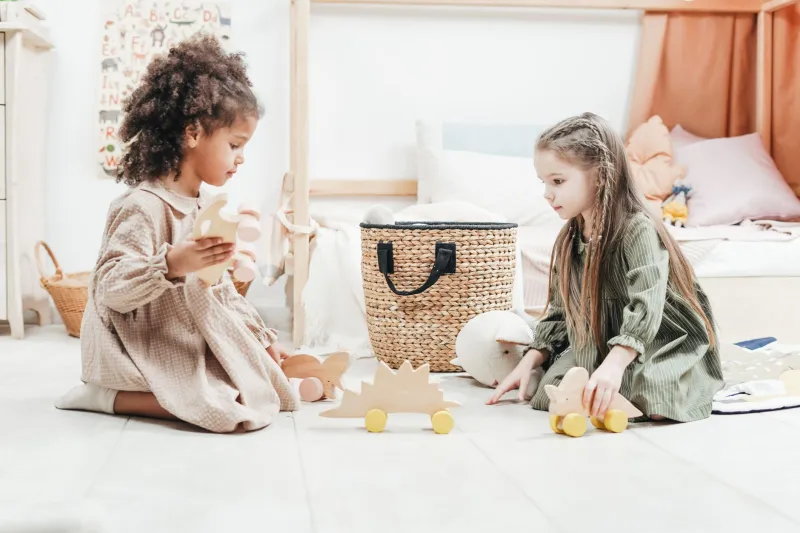
Social-bonding imitation is when a kid mirrors a peer's speech patterns, humor, or style choices. This often spikes around ages 6–10, when belonging to a group becomes increasingly important. It can look alarming (especially when the peer in question has questionable taste in YouTube videos), but it's developmentally normal. Kids are practicing social synchrony—the ability to align with others—which is a real and important social skill.
Creative-inspiration imitation is when a kid is clearly influenced by something they've seen—a drawing style, a story structure, a building technique—but is starting to put their own spin on it. This is the bridge between imitation and genuine originality, and it's worth celebrating when you see it. Point it out: 'I can see you were inspired by Mia's design, and you added this part yourself—that's really cool.'
When Should You Actually Worry?
Okay, so imitation is mostly good. But are there situations where it's worth paying closer attention? Yes, a few.
If imitation is replacing all original attempts, that's worth noting. A child who refuses to try anything without first seeing someone else do it might be struggling with confidence or anxiety. The goal is for imitation to be a starting point, not a permanent substitute for independent effort.
If imitation extends to claiming others' ideas as their own, that's a conversation about honesty and attribution—not a developmental red flag, but definitely something to address directly and calmly.
If a child is imitating a peer who is modeling harmful behavior, the concern isn't the imitation itself but what's being imitated. Same response as you'd have to any worrying influence—address the behavior, understand the attraction, and redirect where needed.
Outside of these situations, most copycat behavior in kids is a feature, not a bug.
How to Support Healthy Imitation at Home
If you want to encourage this natural learning process, a few simple things can help.
Give kids access to models. This doesn't have to be elaborate. Watching an older sibling do something, attending a class where they can observe peers, or even watching age-appropriate how-to videos all give kids raw material to work with. The more they observe, the richer their imitation repertoire becomes.
Do things alongside them, not just for them. When you cook, build, draw, or craft with your kids present, you're giving them something to imitate. Kids learn an enormous amount just from watching a competent adult work through a task in real time—including how to handle mistakes.
Celebrate the progression from copying to adapting. When you notice your kid starting to put their own twist on something they initially copied, make it visible. 'Hey, you started with Lily's idea for the background and then you made it totally your own—that's how a lot of great art gets made.' That kind of observation helps kids understand that imitation is a legitimate starting point, not a shortcut to be ashamed of.
Resist the urge to push for originality too soon. When a child is deep in an imitation phase, asking 'but what would you do differently?' can feel like pressure rather than encouragement. Give them time to absorb what they're learning. The original voice usually shows up on its own, once the technique is solid.
The Copycat Who Becomes the Original
Here's a thought worth sitting with: most of the people we consider genuinely creative—artists, inventors, writers, musicians—spent significant time in their development imitating others. Copying, absorbing, and then slowly, almost imperceptibly, making it their own.
Your kid who spends three weeks drawing in exactly the same style as their best friend isn't lacking imagination. They're building the foundation for it. And one day soon, you're going to look at something they made and think, where did that come from?
The answer, in part, is from everything they watched, absorbed, and quietly made their own. That's not copying. That's how learning works.